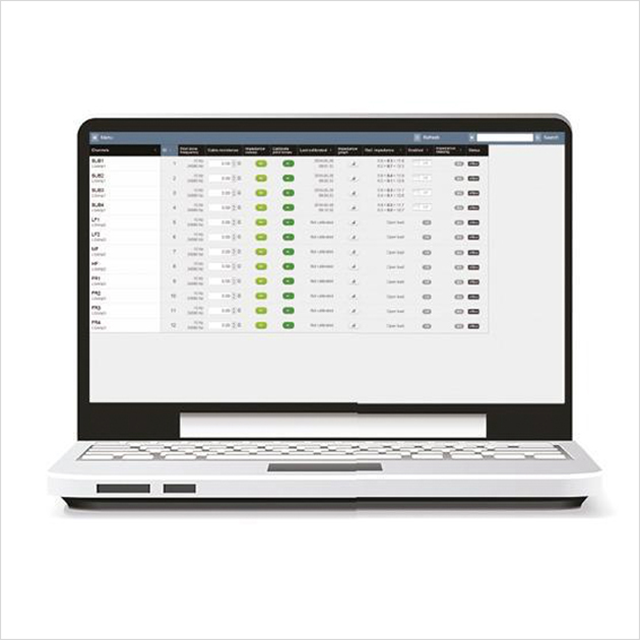
CAFE with ESP: Integrated Software for Fast System Configuration and Surveillance
In addition to providing comprehensive system surveillance and configuration of RPM and other amplifier features such as ISVPL and Breaker Emulation Limiter (BEL), CAFÉ also includes valuable help to save the environment. In combination with the RPM configuration CAFÉ can accurately predict, based on the true SPL and speaker requirements of the individual loads for the given project, estimations of average mains current draw and generated heat in BTU. With our amplifiers' innovative power supply technologies (true Power Factor Correction utilizing Current Draw Modeling) the required mains draw is already best in class in relation to burst power output, but in combination with the BEL the mains draw can also be safeguarded to the predicted level. The end result is precise mains management and thermal control, which allows more accurate (rather than over-specified) provision of mains distribution, cabling and cooling. This technology suite reduces lifetime running costs and minimizes environmental impact. It also reduces demands on UPS systems.
CAFÉ also features an innovative design aid: the Equipment Specification Predictor (ESP). ESP examines the system SPL and speaker requirements for a given project and aids in transforming that data into circuit and amplifier channel requirements. On a system level, CAFÉ supplies a recommendation for optimized placement of channels into amplifiers for the most cost effective solution.
Tools like TeaVM or specialized JVM-to-WASM compilers take the original 1.8.8 Java code and convert it into WebAssembly bytecode.
The Minecraft 1.8.8 update marked a significant milestone in the game's development, introducing exciting new features and gameplay mechanics. The subsequent adoption of WebAssembly has further transformed the game's landscape, enabling improved performance, expanded platform support, and streamlined development.
The experimental WASM-GC runtime represents the future of Minecraft in the browser. Although it is still incompatible with several major browsers (notably Safari) and requires enabling experimental flags in Chrome, the performance improvements are undeniable. As WebAssembly continues to evolve and browser support matures, we can expect these ports to become even more seamless and performant.
The "Minecraft 1.8.8 WASM" community is vibrant and resilient. Many projects host their code on platforms like and use decentralized storage like IPFS to prevent DMCA takedowns. This ecosystem is innovating on multiplayer by using WebRTC for peer-to-peer architecture to keep latency low. The community also focuses heavily on cross-device synchronization , allowing you to build a redstone contraption on a PC and continue on a phone without any re-wiring.
For years, playing Minecraft in a web browser was synonymous with the classic, blocky "Minecraft Classic" version released by Mojang in 2009. However, the landscape of web gaming shifted dramatically with the advent of WebAssembly (WASM). Among the various versions of the game that have been ported to the web, holds a special significance. It represents the bridge between modern Java-based gameplay and the accessibility of the browser, achieved primarily through the teaVM compiler. minecraft 1.8 8 wasm
For archivists, it’s a way to ensure that "the update that changed PvP" remains playable in 2050, when local Java runtimes are museum pieces.
is not a re-creation built from scratch in JavaScript. Instead, it is the actual 1.8.8 codebase (often a modified version of the client) transpiled into WebAssembly.
User experience:
In the context of Minecraft, WASM has opened up exciting possibilities for delivering high-quality, in-browser experiences. With WASM, developers can create optimized, low-level code that runs smoothly in web browsers, eliminating the need for plugins or external software. Tools like TeaVM or specialized JVM-to-WASM compilers take
For developers, it’s a challenge: can you run a JVM inside a browser inside an OS inside… you get the idea.
The journey of Minecraft 1.8.8 from Java code to a browser window is complex.
: The Java source code for Minecraft 1.8.8 was converted into a JavaScript/WASM hybrid. Unlike simple clones, this is a direct port
Detailed comparisons between the 1.8.8 WASM version and the original Java client. The experimental WASM-GC runtime represents the future of
Worlds are saved directly to the browser’s local storage (IndexedDB). Players can create, save, and delete worlds just like on the desktop client.
Early iterations of browser-based Minecraft ports relied entirely on compiling decompiled Java source code into JavaScript using transpilers like TeaVM. While this was a monumental engineering milestone, JavaScript inherently struggled with the heavy garbage collection (GC) and strict object-oriented architecture of vanilla Minecraft Java Edition.
WebAssembly changed this. WASM is a low-level, binary code format that runs with near-native speed in modern web browsers. It acts as a compilation target, allowing developers to take code written in powerful desktop languages like C, C++, or Rust, and run it securely inside a browser engine. The Architecture: Porting Java to the Web
