Originally written: 3/14/2012; last Web page update: 3/13/2020, referencing rEFInd 0.12.0
This Web page is provided free of charge and with no annoying outside ads; however, I did take time to prepare it, and Web hosting does cost money. If you find this Web page useful, please consider making a small donation to help keep this site up and running. Thanks!
| Donate $1.00 | Donate $2.50 | Donate $5.00 | Donate $10.00 | Donate $20.00 | Donate another value |
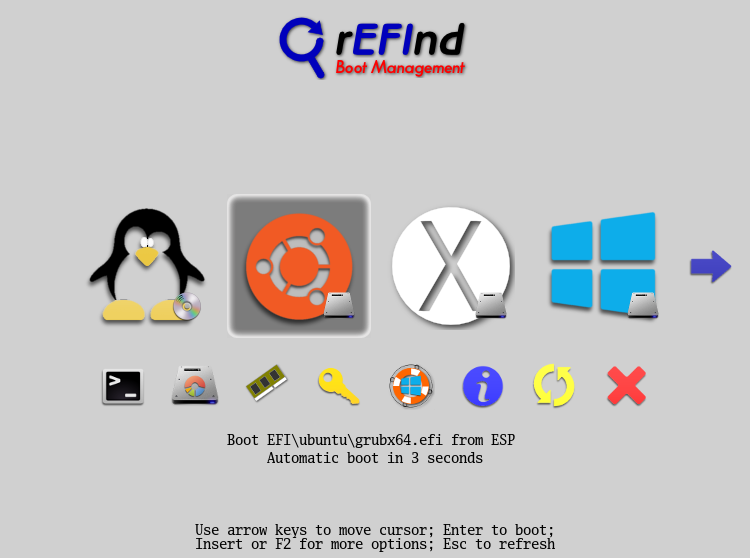
This page describes rEFInd, my fork of the rEFIt boot manager for computers based on the Extensible Firmware Interface (EFI) and Unified EFI (UEFI). Like rEFIt, rEFInd is a boot manager, meaning that it presents a menu of options to the user when the computer first starts up, as shown below. rEFInd is not a boot loader, which is a program that loads an OS kernel and hands off control to it. (Since version 3.3.0, the Linux kernel has included a built-in boot loader, though, so this distinction is rather artificial these days, at least for Linux.) Many popular boot managers, such as the Grand Unified Bootloader (GRUB), are also boot loaders, which can blur the distinction in many users' minds. All EFI-capable OSes include boot loaders, so this limitation isn't a problem. If you're using Linux, you should be aware that several EFI boot loaders are available, so choosing between them can be a challenge. In fact, the Linux kernel can function as an EFI boot loader for itself, which gives rEFInd characteristics similar to a boot loader for Linux. See my Web page on this topic for more information.
Both shortcuts launch the exact same underlying software but instruct the program to load different localization libraries. Method 2: Customizing the Target Shortcut Switch
If the UI doesn't switch properly, restart the computer. If the problem persists, you may need to repair the installation through the Control Panel. Best Practices
The language pack version does not exactly match your AutoCAD update level. Fix: Install the same Service Pack or Update for AutoCAD 2017 before installing the language pack. Match the language pack version (e.g., AutoCAD 2017 SP1 requires the SP1 language pack).
Autodesk released official language packs for AutoCAD 2017 for over a dozen languages, including: Autocad 2017 Language Pack
An AutoCAD 2017 Language Pack is an add-on installer that enables you to run the AutoCAD 2017 interface, dialog boxes, menus, and help files in a language different from the one installed during the initial software installation.
Last updated: 2025 – Note that AutoCAD 2017 is now considered legacy software by Autodesk. Extended support may be limited.
Menus, dialog boxes, tooltips, and command-line prompts are translated. Both shortcuts launch the exact same underlying software
A: Yes. Install them sequentially. You will get a separate shortcut for each in the Start Menu.
If you want, I can convert this into a formatted PDF, generate deployment scripts (SCCM PowerShell or silent MSI commands), or provide sample SCCM task sequence steps and MST transform properties. Which would you like next?
Autodesk's AutoCAD 2017 is a powerful computer-aided design (CAD) software that has been widely used by architects, engineers, and designers around the world. While the software is available in multiple languages, some users may prefer to work in their native language or require support for multiple languages. This is where the AutoCAD 2017 Language Pack comes into play. Best Practices The language pack version does not
You installed a 64-bit language pack on a 32-bit OS, or you are trying to install a full-version pack on AutoCAD LT. Solution: Verify your base version (Help > About AutoCAD). Download the exact matching pack.
If an official pack doesn't exist, you cannot "force" a language. Third-party "translators" exist but are not recommended – they often break the CUI (Custom User Interface) and cause crashes.
Because language packs only change the visual and textual strings, they do not impact the software's rendering speed, stability, or DWG file compatibility.
copyright © 2012–2020 by Roderick W. Smith
This document is licensed under the terms of the GNU Free Documentation License (FDL), version 1.3.
If you have problems with or comments about this Web page, please e-mail me at Thanks.
Return to my main Web page.